Showing posts with label Citi. Show all posts

Tuesday, August 14, 2007

Citibank, Others, Plan Private Stock Platform

NEW YORK (Reuters) - Five of Wall Street's biggest banks, including Citigroup (C.N: Quote, Profile, Research), Lehman Brothers Holdings Inc. (LEH.N: Quote, Profile, Research) and Merrill Lynch & Co. Inc. (MER.N: Quote, Profile, Research), said on Tuesday they were setting up a system to trade privately placed stocks.

The group, which also includes underwriter Morgan Stanley (MS.N: Quote, Profile, Research) and Bank of New York Mellon (BK.N: Quote, Profile, Research), said the new platform would be designed to ease trading for privately sold securities. It will target companies looking to raise capital while avoiding the scrutiny and rules imposed on publicly listed shares.

The Open Platform for Unregistered Securities, or OPUS-5, would also offer an alternative to proprietary platforms introduced by Goldman Sachs Group (GS.N: Quote, Profile, Research), which led the underwriting of a private stock offering for Oaktree Capital Management, and JPMorgan Chase & Co. (JPM.N: Quote, Profile, Research), a lead underwriter for buyout shop Apollo Management.

The group of five expects to launch OPUS-5 system in September. The JPMorgan platform is dubbed "144A Plus."

Separately, Bear Stearns Cos. Inc. (BSC.N: Quote, Profile, Research) on Tuesday announced it has launched Best Markets, a private placement platform, in connection with its role as initial purchaser of a $140 million private placement by J.G. Wentworth, a buyer of illiquid insurance products.

All of these platforms are accessible only to "qualified institutional buyers" -- big money managers that currently participate in private stock and debt transactions.

The news comes a day before Nasdaq Stock Market Inc. (NDAQ.O: Quote, Profile, Research) launches its own platform for private securities called Portal, which has the potential to supersede the bank-run systems.

PRIVATE BOOM

Last year, some $162 billion of unregistered equity shares were sold through U.S. private placements, outpacing the $154 billion raised in public offerings on U.S. exchanges, according to Nasdaq.

The trend has accelerated this year, with a number of closely held hedge and buyout firms choosing to issue shares to investors, but to do so outside the public realm.

Oaktree in May sold 15 percent of itself for $880 million on the Goldman Sachs Tradable Unregistered Equity system, or GSTrUE. Private equity firm Apollo Management sold a 12.5 percent stake, and its shares can now be exchange on the Goldman and JPMorgan platforms.

The five-bank group said OPUS-5 would facilitate trading of equities issued under the U.S. Securities and Exchange Commission's 144a rule, which govern private placements.

Nasdaq said it's received more than 1,700 applications to register placements with Portal this year, about 27 percent ahead of last year's pace.

Nasdaq, which registers private debt and equity placements, said on August 1 that the SEC had approved its plans for Portal. The system will go live Wednesday with roughly 600 issuers, while dealers and qualified investors register to trade on the system, Nasdaq says.

John Jacobs, a Nasdaq Executive Vice President, said that Portal complements the bank-run networks, which track shareholders to ensure private securities have fewer than 500 investors, a requirement under SEC rules.

Nasdaq's system handles companies that register shares with the Depository Trust and Clearing Corp., which currently does not track the number of shareholders. Jacobs said tracking should be in place in about six months, paving the way for closer links among the various platforms.

Jacobs said Nasdaq is in talks with the leading investment banks on the matter.

Tuesday, June 5, 2007

Citi Annual Report - Excited about PBT


In it's Annual Report (Adobe PDF Format) Citibank talks about it's excitement over partnering with Pay By Touch and bringing biometrics to it's customers.

Click on the picture on the left to enlarge and read page 10, which talks about the "innovation" Citi brings with biometrics from the Annual Report.

In a related development, Pay By Touch is telling ComputerWorld Singapore that it has 10 Million Customers enrolled worldwide...mostly in Asia (Asia's Biometric Scanning Craze) and Europe.

Here's an excerpt from that article.


Fingerprint recognition has penetrated the market to a certain degree, and the traditional drawback of this form of biometrics -- cost -- is eroding.

The cost of fingerprint readers has dropped to the point that they are shipping with inexpensive laptops and add-on USB readers can be purchased for as little as $30.


Another advantage of fingerprint based authentication is that it smoothly bridges the offline and online worlds. Pay By Touch, a provider of fingerprint-based authentication, gained its early traction in retail settings, using fingerprint authentication as a replacement for debit cards, check-cashing services and as a way to store shopper information without forcing customers to carry around store loyalty cards.

"According to Pay By Touch, its authentication service is used by more than 10 million consumers at more than 3,000 retail locations. Most are in Europe and Asia",
but several chains in the United States, including Albertsons, Jewel-Osco and Lowes Foods, have started rolling out the service. As consumers get comfortable with this as a means of brick-and-mortar shopping, Pay By Touch intends to extend this to the online world.

Friday, March 16, 2007

ZDNet Asia- Fingers Will Replace Cards

weekly roundup
by Eileen Yu, ZDNet Asia
No cash? Show me your fingerCan't Leave Home Without It...
Credit card giant Visa has declared that by 2012 credit and debit cards would become cheaper and more convenient than cash, and boldly anticipated that retailers could start making customers pay a surcharge if they paid with cash.

I think Visa got it half right. Yes, cash may indeed be on its way out.
But, I think the same can be said for credit and debit cards. Instead, what's coming up is...your finger.

Citibank Singapore (click for Citi/PBT Site) has been driving a marketing campaign to encourage customers to use its new biometric payment service, dubbed Pay By Touch. Officially launched late last year, consumers can swipe their finger to pay for their beverage at Coffee Bean & Tea Leaf or booze at Zouk. According to Citibank, millions in the U.S. already use Pay By Touch.

Overview

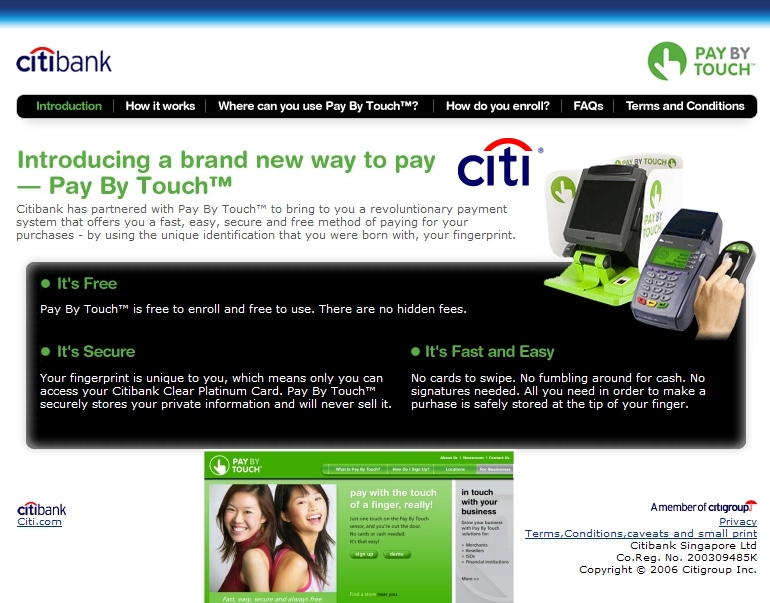
Citibank has partnered with Pay By Touch™ to bring to you a revolutionary payment method that is fast, easy, and secure. Using the identification that you were born with, your unique fingerprint, you can now pay with just one touch.

I'm a sucker for credit, and other forms of plastic cards, because each offers rebates and discounts at various dining and shopping outlets that I frequent. I use a different one each time to get additional discounts at the petrol kiosk Caltex, department store Robinsons and phone accessories at M1 outlets, and to earn rebates when I get my groceries at Carrefour.

That's four credit cards already, and I haven't listed the other discount cards that I have crammed into my wallet--or "the brick", as some of my friends call it. If I could leave all the plastic at home, it'll be a load off my shoulder, literally, because they do feel heavier in my bag after a long day.

But, for biometrics to take off as a viable payment option in Singapore, or anywhere else in Asia for that matter, it cannot be supported only by a handful of merchants. You can't exactly leave your cash and credit cards behind if your neighborhood corner shop doesn't accept your fingerprint as a form of payment. Of course, I'm not telling Citibank anything they don't know. They state that the biometric payment technology will be introduced to other retailers in the near future.

With
identity theft and fraud on the rise, biometric security tools may just be the answer--though you could very well end up with a blistered finger at the end of the day.

So, where does that leave credit card companies if we no longer need plastic in future? They still have a role to play as a payment processing facility, but more importantly, they need to continue to focus on providing better customer service. Time to waive all annual subscription fees, permanently? In addition, banks and other financial players will need to
beef up their security infrastructure to ensure all the data that's collected to facilitate biometric transactions are well protected.

Now, if only
IT products have fingerprints, too.

Would you
pay by finger?


Here's how Citi's Biometric Payment Works...


Put your finger on the reader then enter your personal search number (usually your NRIC number)
Enter your search code (usually your NRIC)
Take your purchases and go!


Tuesday, February 27, 2007

Biometric Firms Gaining Momentum


Biometrics is big and getting bigger thanks to a troika of Bay Area diehards.

Biometric technologies (and the supporting software and integrators) raked in an estimated $2.1 billion last year. That's up $800 million from 1999 and on track to hit $7.4 billion by 2012, according to the International Biometric Group.

Retinal, fingerprint and facial identification technologies (and the supporting software and integrators) raked in an estimated $2.1 billion last year. That's up $800 million from 1999 and on track to hit $7.4 billion by 2012, according to the International Biometric Group.

"Before it was primarily a matter of survival. Now it is not," said DigitalPersona CEO Fabio Righi.

Founded in 1996, the Redwood City company scored some initial interest from market movers Visa and Microsoft, but that only turned to cash in recent years. The 75-person company, which makes both fingerprint reading hardware and the software that supports it, secured customer Banco Azteca in Mexico last March. Eight million bank members registered initially, a group that has grown to 14 million. Although Righi declined to disclose revenue, he confirmed his company has been profitable since 2004, a major, and often postponed milestone.

Emeryville-based Upek, which sometimes competes with DigitalPersona, is also prospering. Having spun off from STMicroelectronics in 2004, the company logged its first full year of revenue in 2005 at $30 million. Last year it rang in $52 million and 2007 also looks strong. An IPO could be in the offing.

"Today, the biggest driver of our revenue is the notebook market," said CEO Alan Kramer, saying notebook customers IBM, Dell, Toshiba and Sony represent roughly 80 percent of the company's revenue.

Since Upek sensors debuted on IBM's Lenovo notebooks in 2005 -- the first widespread launch of biometrics to average consumers -- the company has fortified its technology and begun bundling software to create a one-stop shop for customers. Upek is now the first and only silicon sensor vendor approved by the General Service Administration for deployment by Uncle Sam.

San Francisco-based Pay By Touch, which partners with both Upek and DigitalPersona, is also on the fast path with an potential IPO on it's slate. Having raised $300 million during the past six years in debt and equity financing from angels, including Craig Ramsey and the Gordon Getty Family Trust, and hedge funds like Scout Capital Management, the company now employs 800.

The most recent $60 million infusion, completed in January 2006, enabled it to acquire marketing company S&H Solutions and accelerate its own sales and marketing. Pay By Touch recruited Mayor Gavin Newsom's father, the Honorable Judge William Newsom, and Sapient co-founder Stuart Moore as board members and added former Home Depot executive vice president John Costello to its management team also in the past year.

The company now counts 3.5 million registered users, all paying for groceries, coffee, movies and other retail items by touching their finger to a reader at the point of purchase. User prints are linked to their bank, credit cards and other accounts, so once the print is authenticated, the bank processes the payment as usual.

"The market's really starting to explode. People no longer just think of biometrics as science fiction and on the edge," said President and COO John Morris.

Pay By Touch has systems installed in the United States, Britain and Citibank outlets in Singapore.

The company will offer Chicago motorists the chance to pay at the pump this spring.

So why is the age-old technology of reading fingerprints getting new growth?

Password fatigue is increasing while biometrics costs are decreasing. Morris said it costs $300 to install a Pay By Touch system in a checkout lane, compared with $2,000 three years ago. Said Morris: "It's about getting the technology rolled out and putting it where people can use it."

lwilson@bizjournals.com / (415) 288-4939

Tuesday, December 5, 2006

ZDNet Asia On Citibank/PBT Partnership


Biometrics' answer to identity verification
By Lynn Tan, ZDNet AsiaTuesday , December 05 2006 05:25 PM

The million-dollar question: How secure is fingerprint authentication?

Those that have implemented the technology, however, emphasize there is little cause for worry.

According to M.N. Rangaraj, senior country operations officer of Citibank Singapore, the Pay By Touch fingerprint authentication system that the bank uses does not capture images of the fingerprint. Citibank launched in November
the world's first biometric cardless payment service for credit card transactions.

Instead, the system looks for certain aspects of the ridges on the finger, also known as
minutiae points, and encrypts them in numerical format--in a series of numbers that cannot be used to reverse engineer and recreate an image, Rangaraj explained in a phone interview with ZDNet Asia.

To safeguard customers' information, "neither biometric nor financial information is stored at the retail location, and fingerprint [data] is not transmitted back and forth to the point of sale", according to Krista Thomas, vice president of corporate communications at biometric authentication vendor Pay By Touch, in an e-mail interview.

All the encrypted data are stored at "secure IBM data centers, which abide by financial industry security standards", in a completely separate database from all other personally identifiable information--such as name, address, and financial account information, Thomas explained.

"In fact, these IBM servers are located in fortress-like facilities with security guards, bulletproof glass, mantraps, biometrics, video cameras and alarmed doors--like in a scene out of Mission: Impossible," she said.

According to Thomas, Pay By Touch also performs security audits and vulnerability tests with external security experts routinely to ensure security on an ongoing basis.

"Our encryption is better than--the security used to protect your ATM PIN code, which has been seen as the model to strive for in the industry," Thomas said.

According to Thomas, the fingerprint authentication system also helps to deter fraud. Writing checks, for instance, creates multiple opportunities for fraud because it lets "as many as 10 people view the information on a check before it is processed".

In contrast, she explained, the Pay By Touch system does not even let the cashier see a customer's payment information as the data is encrypted. "If you write just five checks in a week, that creates 50 opportunities for fraud," Thomas noted.

Is it foolproof? The biometric system authenticates the transaction by matching the data captured from the user's finger ridges at the point of the transaction to the encrypted data stored in the secured database, Rangaraj explained.

Before the transaction is approved, the user would also be required to key in a seven-digit "Personal Search Number" after pressing their finger to a biometric scanner as an added layer of security.

However, a replicated copy of the fingerprint image will not work as fingerprints do not carry minutiae points. Rather, the system requires the actual finger to be on the authentication device so that the sensor can detect certain unique characteristics of the finger, Rangaraj said.

On top of that, the sensor will also automatically check for moisture and warmth of the finger, he added. As such,
prosthetic or fake fingers will also not work, Rangaraj said. ZDNet Asia understands from Pay By Touch that while some finger sensors detect pulse and heat, the sensors that the company is presently using do not have these functions.

Consumers' choice

According to Thomas, a recent study conducted by IT services vendor Unisys revealed that consumers around the world are becoming more comfortable with biometrics.

Results of the research released in April this year indicated that "70 percent of consumers worldwide support the use of biometric technologies to verify their identity, while 66 percent [of consumers] favor biometrics as the ideal method to combat fraud and identity theft as compared to other new payment methods such as smart cards and tokens", Thomas said.

Pay By Touch launched its fingerprint authentication system in Thriftway Supermarket in Seattle in 2002. To date, the San Francisco-based company has worked with several retailers, including a small grocery chain in the United Kingdom and larger brands such as Albertsons' Jewel Osco chain in Chicago, SUPERVALU's Farm Fresh in the Southeast, and Lowes Foods in the Midwest, to use biometrics as a form of authentication commercially.

Wednesday, November 22, 2006

Citibank Roll Out to Be Quick


This is the first time that Citibank has tested a biometric payment system, and the bank's operations in other countries, especially in Asia, are watching what happens in Singapore with interest, Cavale said.

"Our plans include taking this technology around the region," he said.

"Our intention is to roll it out very quickly to other cards," Cavale said.

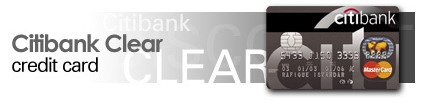
Citibank chose to start the rollout of the biometric payment system with the Clear Platinum card
because it is targeted at younger Singaporeans, ranging in age from 25 to 34. "We launched with this segment because the uptake is going to be very strong," he said.

Getting signed up to use the biometric payment system, provided by Pay By Touch, of San Francisco, is relatively easy.

Citibank has installed Pay By Touch kiosks at several Singapore branches


Tuesday, November 21, 2006

Citibank to Expand Pay By Touch Offering


Citibank this month began rolling out biometric payment systems in Singapore that allow Citibank Clear Platinum credit card holders to pay using their fingerprints and says they plan to expand the platform to other regions and other cards.

"It's an investment for our future," said Anand Cavale, vice president and business director of credit payment products at Citibank Singapore, noting this is the first time the bank has used a biometric payment system anywhere in the world.

Before putting the biometric system into operation, Citibank officials took a long hard look at whether the system was secure -- and came away satisfied that it was, Cavale said. "We see this as the next step, which will enhance our already good fraud prevention systems," he said.

With an affluent, tech-savvy population of 4.5 million, Singapore is among the most competitive for credit-card issuers, with many Singaporeans carrying three or four cards in their wallets. To encourage card holders to spend, banks regularly team up with partners to offer special discounts -- say, 10 percent off dinner at a trendy restaurant -- if customers use a certain credit card.
So much competition leaves banks looking for any edge they can find.

For its part, Citibank hopes the biometric technology makes payment more convenient for its card holders, eliminating the need for them to always carry credit cards while still allowing them to buy things. But don't expect to see biometrics replace Citibank cards any time soon. "The technology will be used in conjunction with a credit card," Cavale said.

Cavale believes biometric payments systems will shine in applications where a quick payment method is needed. "If you're running to catch a train, and buying a cup of coffee and a newspaper, your time has more value," he said.

So far, Citibank's biometric payment systems are only in place at a handful of outlets in Singapore, including local coffee shops and the popular Zouk night club.

The bank has plans to quickly expand the number of such systems and the number of Citibank card holders able to use them.

"Our intention is to roll it out very quickly to other cards," Cavale said. Citibank chose to start the rollout of the biometric payment system with the Clear Platinum card because it is targeted at younger Singaporeans, ranging in age from 25 to 34. "We launched with this segment because the uptake is going to be very strong," he said.

Getting signed up to use the biometric payment system, provided by Pay By Touch, of San Francisco, is relatively easy. Citibank has installed kiosks at several Singapore branches where card holders can register their fingerprints. To sign up, Citibank customers need to provide valid photo identification and a seven-digit numeric passcode used with the fingerprint to authenticate payment.

This is the first time that Citibank has tested a biometric payment system, and the bank's operations in other countries, especially in Asia, are watching what happens in Singapore with interest, Cavale said. "Our plans include taking this technology around the region," he said.

Wednesday, November 15, 2006

Citibank Introduces World's First Biometric Credit Card

SINGAPORE: Singaporeans will be among the first in the world to use a biometric credit card.

Citibank - the world's largest credit card issuer - has chosen to launch its biometric credit cards in Singapore.

With the biometric payment system, card users do not even need to carry their cards with them.

The Citibank/Pay By Touch biometric system is expected to
revolutionalise the way people shop and make payments.

Shoppers no longer need to present their credit card and sign for payment. Instead, it will just be a matter of having a finger scan followed by the keying in of a PIN number.

The bank is first introducing the card to some 190,000 cardholders between the age of 25 and 34. These users, according to the bank, spend an average of $800 a month on their credit cards.

Jonathan Larsen, CEO and Country Manager, Citibank Singapore, said, "We're launching this biometric payment solution as part of our launch of the Platinum Clear Card.

And for the next couple of months, we will focus on making the biometric solution available to our Clear customers. However, very shortly thereafter,
we will be broadening this to all Citibank cardholders..."

The system uses technology belonging to Pay By Touch, a global biometric authentication and payment solutions provider. And Citibank will be the first credit card issuer in the world to use it.

Citibank says i
t plans to eventually expand the service to all of its one million Singapore customers.

Citibank plans to gradually introduce this payment system to other parts of Asia Pacific.

Translation: Every Asia-Pacific Region where Citibank's Platinum Clear Card is offered becomes, potentially, Pay By Touch territory. Currently, the Clear Card is being offered in the following Asia Pacific regions: Click any to go to the respective Citibank Platinum Clear Card Sites


Malaysia
The Phillipines
Taiwan
Thailand
Australia


Friday, November 10, 2006

Citibank is Singapore Connection

Ground-Breaking Initiative Provides Citibank Cardholders with Unprecedented Payment Convenience and Added Security

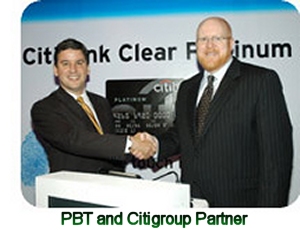
Pay By Touch, the global leader in integrated biometric authentication, personalized marketing and payment solutions, announced that Citibank Singapore has rolled out Pay By Touch's biometric payment services to its Citibank Clear Platinum cardholders. Effective today, cardholders are invited to enroll in the biometric credit card service, and pay for goods and services with the touch of a finger.

"Today's launch of our new biometric payment service in partnership with Pay By Touch gives our cardholders a whole new level of empowerment, marking a major milestone not just for Citibank but also for the card industry," said Jonathan Larsen, CEO and Country Business Manager, Citibank Singapore Ltd.

"With the credit card becoming very much a part of our daily lives, consumers want greater flexibility in making payments. We are proud to bring the world's first cardless biometric payment service to Singapore. This is the ultimate in convenience – the ability to make credit card transactions with just a finger scan."

"The biometric credit card service from Citibank and Pay By Touch sets a new standard for speed, convenience and security," said John Rogers, founder, Chairman and CEO, Pay By Touch.

"Together, we have eliminated the need for cardholders to present their credit cards when paying for purchases. Instead, they simply press their finger to a biometric scanner and, in seconds, their transaction is complete."

The new biometric payment service is available to Citibank Singapore's Clear Platinum cardholders as part of the launch of its new Clear Platinum card. To start, Citibank Clear Platinum cardholders will be able to make cardless credit card transactions at retail outlets such as music and IT stores, as well as clubs, restaurants and cinemas. Participating merchants include Zouk, Gramophone epiCentre, Coffee Bean & Tea Leaf and Shaw Theatre.

The biometric payment service will be introduced to more merchants and other Citibank credit cards in the near future. "We are pleased to be working with Citibank Singapore to bring an innovative and differentiating feature to the new Clear Platinum card in a crowded, highly competitive marketplace," said Drew Hyatt, Senior Vice President, Card and Authentication Services, Pay By Touch. "Already, millions of Americans love using Pay By Touch because it's a faster, easier and more secure way to pay. We are confident that Singaporeans will feel the same way."

The biometric payment service is available free-of-charge to Citibank Singapore's Clear Platinum cardholders. Enrolment takes minutes, and requires only a government-issued photo ID, a Citibank Clear Platinum credit card and a secure finger scan. Cardholders also create a seven-digit Personal Search Number, which facilitates the use of their scanned finger image to authenticate payment transactions.

The biometric enrollment kiosks will initially be made available at five branch locations: Citibank Singapore's Orchard Road, Paragon, VivoCity and Parkway Parade branches and Zouk. More kiosks will be available at other branches and merchants in future.

About Citibank

Citibank is a member of Citigroup (NYSE: C), the leading global financial services company which has some 200 million customer accounts and does business in more than 100 countries, providing consumers, corporations, governments and institutions with a broad range of financial products and services, including consumer banking and credit, corporate and investment banking, securities brokerage, and wealth management. Major brand names under Citigroup's trademark red umbrella include Citibank, CitiFinancial, Primerica, Smith Barney, and Banamex.

Additional information may be found at: www.citigroup.com

Thursday, November 9, 2006

Citibank Partners with Pay By Touch

Citibank rolls out world's first biometric credit card service, targets yuppies here in Singapore - Chow Penn Neepennnee@mediacorp.com.sg

Citibank has just raised the bar for the credit card market. .You won't even need a physical card any longer to party, dine or shop. All you will need is your finger, for a scan.

Rolling out the world's first biometric credit card service yesterday, the American bank is targeting Singapore yuppies for the launch, before extending it to the rest of its over 700,000 card members here.

With the free service, cardholders need only press their finger to a biometric scanner located at participating stores. Currently, only nine outlets offer this service but others will be roped in.

Not only can customers cut down on payment queue times, they have the added protection against card fraud, said Mr Jonathan Larsen, chief executive officer and country business manager, Citibank Singapore.

"With the credit card becoming very much a part of our daily lives, consumers want greater flexibility in making payments," he said, adding that this move will transform the local payments industry.

The global bank is also looking at using biometrics for Internet banking. Other forms of biometrics involve authentication via facial and voice recognition.

Commenting on the security of the system, Mr John Morris, president and chief operating officer of US-based technology partner Pay By Touch, said the service has "military-level encryption" to ensure data security.

To assuage fears that the data collected would be misused along the way, Mr Larsen said that the digitised fingerprints are encrypted and stored in different databases from other information like the name and card numbers of cardholders.

This keeps the information separate and prevents abuse, said the bank.

Mr Larsen declined to reveal the investment amount of its biometric service, except to say it is in the "multi-million" range. Citibank plans to roll out the platform to all it's cardholders in Singapore and then move on to Malaysia and the Mainland. They also plan to use the Pay By Touch biometric platfrom for online banking and purchasing over the Internet, which is, at the end of the day, why they are partnering with Pay By Touch in the first place.

It certainly raises the competition for a market that has seen a slew of creative concepts over the years — such as shrinking the cards by half — to woo the crowds. On whether the latest biometric system will take off, intellectual property lawyer Bryan Tan said: "It's innovative. The current card technology has flaws, as we have seen from security breaches in cloning of credit cards." But he added that its popularity would depend on acceptance by both merchants and users. Merchant's certainly have a vested interest since biometric ACH transactions cost about a third less than debit transactions, which in turn, cost about 25% less than credit card transactions.